
RESEARCH PAPER
Characteristics of Trichoderma strains from the IAFB Collection of Industrial Microorganisms in terms of their possible practical applications

1
Department of Microbiology, Prof. Wacław Dąbrowski Institute of Agricultural and Food Biotechnology—State Research Institute, Poland
Submission date: 2026-03-02
Final revision date: 2026-07-16
Acceptance date: 2026-09-08
Publication date: 2026-09-09
Corresponding author
Sokolowska Barbara
Department of Microbiology, Prof. Wacław Dąbrowski Institute of Agricultural and Food Biotechnology—State Research Institute, Rakowiecka 36, 02-532, Warsaw, Poland
Department of Microbiology, Prof. Wacław Dąbrowski Institute of Agricultural and Food Biotechnology—State Research Institute, Rakowiecka 36, 02-532, Warsaw, Poland
Food Biotechnology and Agricultural Science 2026;80:8-19
KEYWORDS
TOPICS
ABSTRACT
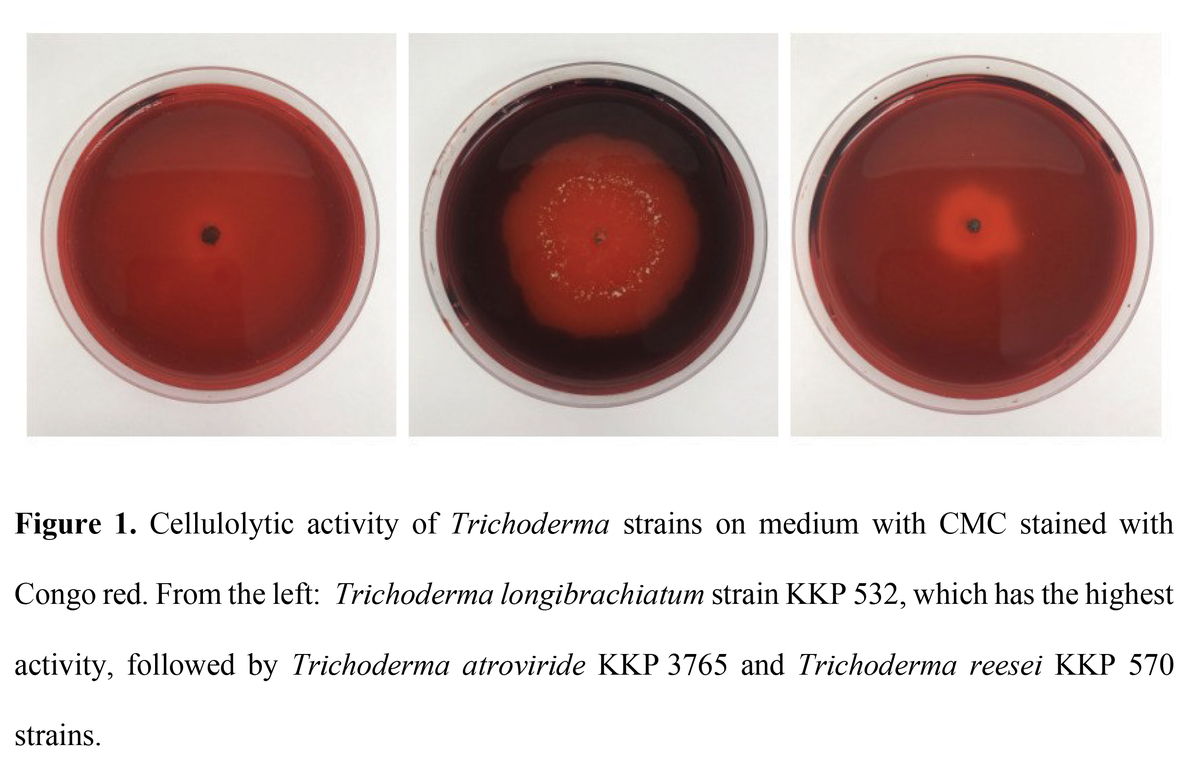
Trichoderma spp. are widely recognized as multifunctional biological control agents whose efficacy is based on a combination of enzymatic activity, direct antagonism, and secondary metabolite production. This study evaluated the biocontrol potential of Trichoderma strains from the IAFB Collection by analyzing extracellular enzymatic activity, direct antagonism against phytopathogens, and volatile organic compound (VOC) - mediated inhibition. Plate assays revealed strong and strain-dependent production of cellulases, chitinases, and lipases. All 14 strains exhibited cellulolytic activity, while chitinolytic and lipolytic activities were detected in 10 and 12 strains, respectively. Dual-culture assays against 13 plant pathogenic fungi demonstrated broad-spectrum antagonism, with inhibition of radial growth ranging from 5.9% to 80%. T. longibrachiatum KKP 532, T. atroviride KKP 3765, and Trichoderma sp. KKP 3537 showed particularly strong and consistent inhibition across multiple pathogens. Volatile-mediated inhibition was generally weaker but detectable, reaching up to 38% inhibition and confirming the contribution of VOCs to indirect antagonism. Overall, the results demonstrate a multifactorial mode of action combining enzymatic degradation, rapid competitive growth, mycoparasitism, and volatile metabolite production. The studied strains represent promising candidates for further development as environmentally friendly biocontrol agents for sustainable plant protection, as well as for use in the industry and biotechnology.
| eISSN: | 3071-7264 |
| ISSN: | 3071-7256 |

We process personal data collected when visiting the website. The function of obtaining information about users and their behavior is carried out by voluntarily entered information in forms and saving cookies in end devices. Data, including cookies, are used to provide services, improve the user experience and to analyze the traffic in accordance with the Privacy policy. Data are also collected and processed by Google Analytics tool (more).
You can change cookies settings in your browser. Restricted use of cookies in the browser configuration may affect some functionalities of the website.
You can change cookies settings in your browser. Restricted use of cookies in the browser configuration may affect some functionalities of the website.