
REVIEW PAPER
Risk Assessment and Food Safety within the One Health Framework

1
Department of Microbiology, Prof. Waclaw Dabrowski Institute of Agricultural and Food Biotechnology-State Research Institute, Poland
Submission date: 2026-02-17
Final revision date: 2026-09-21
Acceptance date: 2026-09-24
Publication date: 2026-11-22
Corresponding author
Joanna Bucka-Kolendo
Department of Microbiology, Prof. Waclaw Dabrowski Institute of Agricultural and Food Biotechnology-State Research Institute, Warsaw, Poland
Department of Microbiology, Prof. Waclaw Dabrowski Institute of Agricultural and Food Biotechnology-State Research Institute, Warsaw, Poland
Food Biotechnology and Agricultural Science 2026;80:30-39
KEYWORDS
TOPICS
ABSTRACT
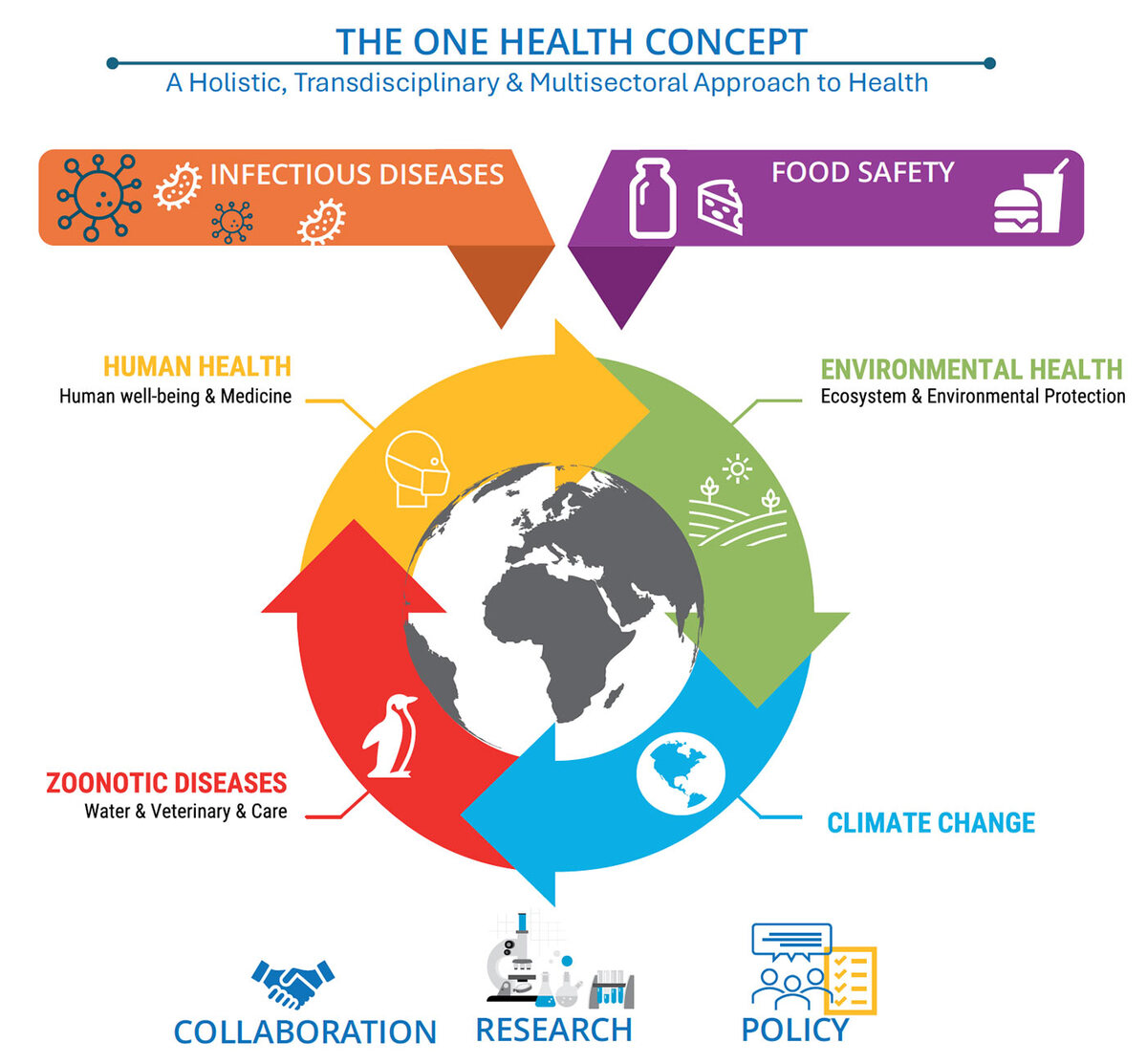
Food safety risk assessment is increasingly considered within the One Health framework, which recognises the interdependence of human, animal and environmental health in the emergence and transmission of food-chain hazards. In the European Union, risk analysis is based on Codex Alimentarius principles and the functional separation of risk assessment, risk management and risk communication. This narrative review examines how a One Health perspective affects the four established stages of food safety risk assessment and how they are implemented within the European institutional system, particularly through the European Food Safety Authority (EFSA). The reviewed evidence indicates that One Health does not replace the classical risk-assessment paradigm. Instead, it broadens the range of relevant exposure pathways and the institutional interfaces considered during hazard identification, hazard characterisation, exposure assessment and risk characterisation. The clearest operational examples concern zoonotic diseases and antimicrobial resistance, where data from human health, animals, food, feed and the environment must be interpreted together. EFSA and partner agencies have developed joint surveillance reports, scientific networks, emerging-risk procedures and cross-agency cooperation mechanisms, however, limitations remain. The European Food Risk Assessment Fellowship Programme (EUFORA) is considered a capacity-building instrument of the One Health framework. Future progress will depend on interoperable data systems, transparent uncertainty analysis, stronger environmental surveillance, sustained inter-agency governance and careful evaluation of new genomic and metagenomic tools. This review presents One Health-based food risk assessment as an extension of established scientific methods whose full implementation requires organisational as well as methodological change.
| eISSN: | 3071-7264 |
| ISSN: | 3071-7256 |

We process personal data collected when visiting the website. The function of obtaining information about users and their behavior is carried out by voluntarily entered information in forms and saving cookies in end devices. Data, including cookies, are used to provide services, improve the user experience and to analyze the traffic in accordance with the Privacy policy. Data are also collected and processed by Google Analytics tool (more).
You can change cookies settings in your browser. Restricted use of cookies in the browser configuration may affect some functionalities of the website.
You can change cookies settings in your browser. Restricted use of cookies in the browser configuration may affect some functionalities of the website.